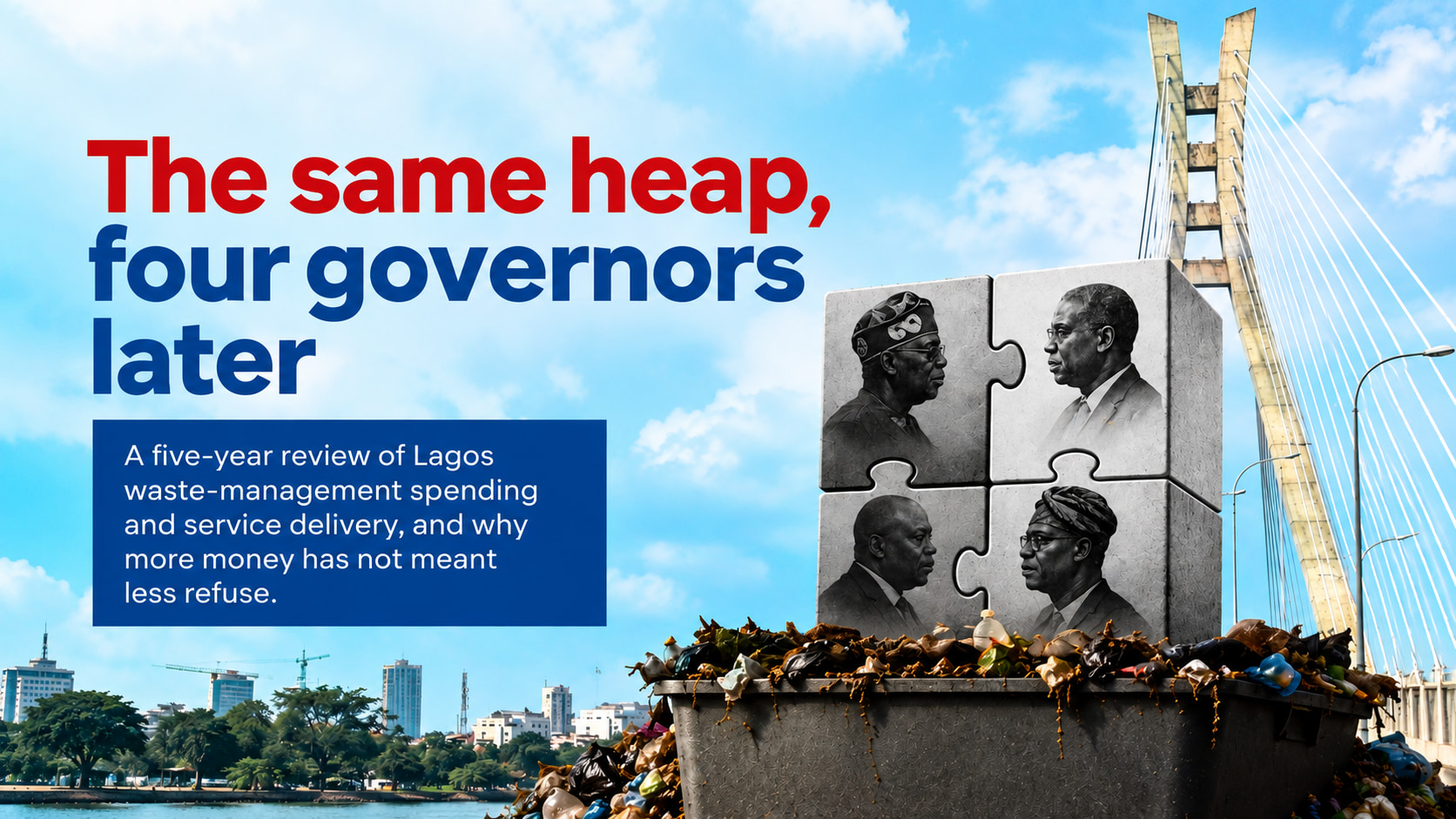
Lagos has spent decades trying to solve its waste problem.
Different administrations have introduced new models, restructured waste collection, expanded private-sector participation and committed significant public resources to the sector. Yet, across the city, the same problem continues to return: waste accumulates faster than the system can reliably collect it.
As part of CISD’s Urban Detox project, we examined what happens when we look beyond the visible heaps and examine the system behind them.
This five-year review of Lagos’ waste-management spending and service delivery asks a simple but important question:
When spending increases, why does the waste problem keep coming back?
Four governors. Multiple reforms. One recurring problem.
Lagos’ waste-management journey has gone through several major reforms, from the establishment and expansion of the PSP model to the Cleaner Lagos Initiative and subsequent efforts to recapitalise and restructure waste collection.
Yet the timeline tells a recurring story: reform, restructuring, implementation challenges, service gaps and emergency response.
The problem, therefore, cannot be understood simply as a shortage of money.
The numbers tell a different story
Our review found that Lagos’ environment budget grew by approximately 2.5 times between 2024 and 2026, while the total state budget grew by about 1.9 times.
At the same time, Lagos generates an estimated 13,000–15,000 tonnes of waste every day, but only about 4,000–5,000 tonnes are collected.
That leaves a collection gap of roughly two-thirds.
So the question becomes:
What happens between the money being budgeted and the waste actually being collected?
When spending does not translate into service
The review also examines the Cleaner Lagos Initiative as a case study of how large financial commitments can fail to produce lasting system improvements.
The initiative involved a ₦28.47 billion five-year bond at 17.5%, alongside a monthly first-line charge of ₦713.7 million for 49 trucks.
Yet the initiative collapsed within roughly three years. PSP operators were recalled, while Lagos continued servicing the financial obligations associated with the programme.
The case illustrates a wider problem: A waste-management system also requires sustainable financing, capable operators, reliable collection infrastructure, functioning payment systems and continuity in policy.
The cycle that keeps Lagos trapped
Urban Detox identifies a reinforcing cycle at the heart of the problem:
Rising operating costs → higher tariffs → non-payment → fleet deterioration → missed pickups → declining willingness to pay → further service deterioration → emergency evacuation.
The cycle eventually closes by returning to the beginning.
Emergency clean-ups may remove the waste temporarily, but without fixing the system that produced the accumulation, the same problem returns.
The accountability question
The central question emerging from this review is not simply how much Lagos spends on waste management.
It is:
Who is accountable for the gap between what is spent and what is delivered?
That means looking at the entire chain: government spending, operator performance, collection capacity, tariffs, payment compliance, service standards, monitoring and policy continuity.
The Urban Detox lesson
The Lagos case shows why urban waste cannot be treated only as a sanitation or environmental problem.
It is also a systems problem.
A sustainable waste-management system needs a reliable disposal chain, transparent financing, workable payment mechanisms, professionalised operators, clear institutional responsibilities and policies that can survive beyond individual administrations.
Urban Detox is about looking beyond the heap to understand the system that keeps producing it.
This review is part of that work.
Download the full Urban Detox report to explore the evidence, timeline, spending patterns, service-delivery gaps and accountability questions behind Lagos’ recurring waste crisis.